Maintenance as a Performance Lever
Maintenance execution directly impacts NOI, retention, leasing velocity, operating expenses, and asset risk. Most maintenance organizations are managed at the activity level. We manage it at the asset-performance level. Absolute is built on 25+ years of experience across in-house, third-party, and field operations — with project-management expertise and process standardization at the core.
For apartment communities, maintenance is the single largest driver of retention, turn velocity, and operating-cost discipline at the asset level. Absolute replaces fragmented contractor coordination with a single accountable operating layer — aligned to ownership objectives, reported in the language asset managers, lenders, and ICs already read.
What an unmanaged maintenance operation actually looks like at the site.
Property managers start the morning with meetings about fires to put out. They delegate tasks to maintenance staff, order materials, and orchestrate the day. Leasing agents spend the morning scheduling service calls for residents. Move-ins wait to be leased until the unit is punched. Techs wait to punch units until the service calls are done.
Door and window replacements, clogged drains, flooring, painting — all get sent to contractors. Everyone stops to open doors, schedule, and check the work of vendors. Each vendor has a different standard. The new resident has a different one. Techs have limited skill sets, sites have limited techs, and it’s not practical to add temporary staffing through high peaks. Overtime isn’t budgeted for peak season — or if it is, it drops the pay rate. Teams make do when short-staffed.
A property manager has to approve or orchestrate it all. New staff has to be trained — by the same staff trying to keep things running.
A maintenance management partner changes that.
Operational bottlenecks are reduced by additional field leadership. Skills training and trade-level expertise become available that weren’t before. Leasing agents prioritize revenue-generating activities instead of dispatching repairs. Property managers provide oversight rather than putting out fires.
Unit punches are completed to the same standard, on timelines leasing agents can lease up against. Work orders are resolved without being chased — and without three attempts because there’s no one to train on the task. Vendors are managed against an operating standard. The day stops being reactive.
The maintenance program stops being something the site team manages around. It becomes the operating layer the asset runs on.
What we operate at the asset
A complete, program-managed multifamily maintenance program — not a list of disconnected services.
▲ Outcome Accountability
NOI is built on operating performance. The maintenance program is reported against the metrics asset managers, lenders, and ICs already use — at a weekly cadence.
Why the discipline matters
Resident retention compounds against rent roll growth. Faster turns compound against NOI. Operating-cost discipline compounds against the cap rate at exit. The reporting cadence holds in an LP letter, an IC update, or a refinance file.
Built for Multifamily & Apartment Communities
Bring Absolute in before the operating cadence becomes the constraint.
Absolute operates as the accountable maintenance management layer between site execution and portfolio performance. A scoping conversation with the asset team — a short call, an asset walk where the timeline warrants it, and an honest read on whether we are the right operating partner.

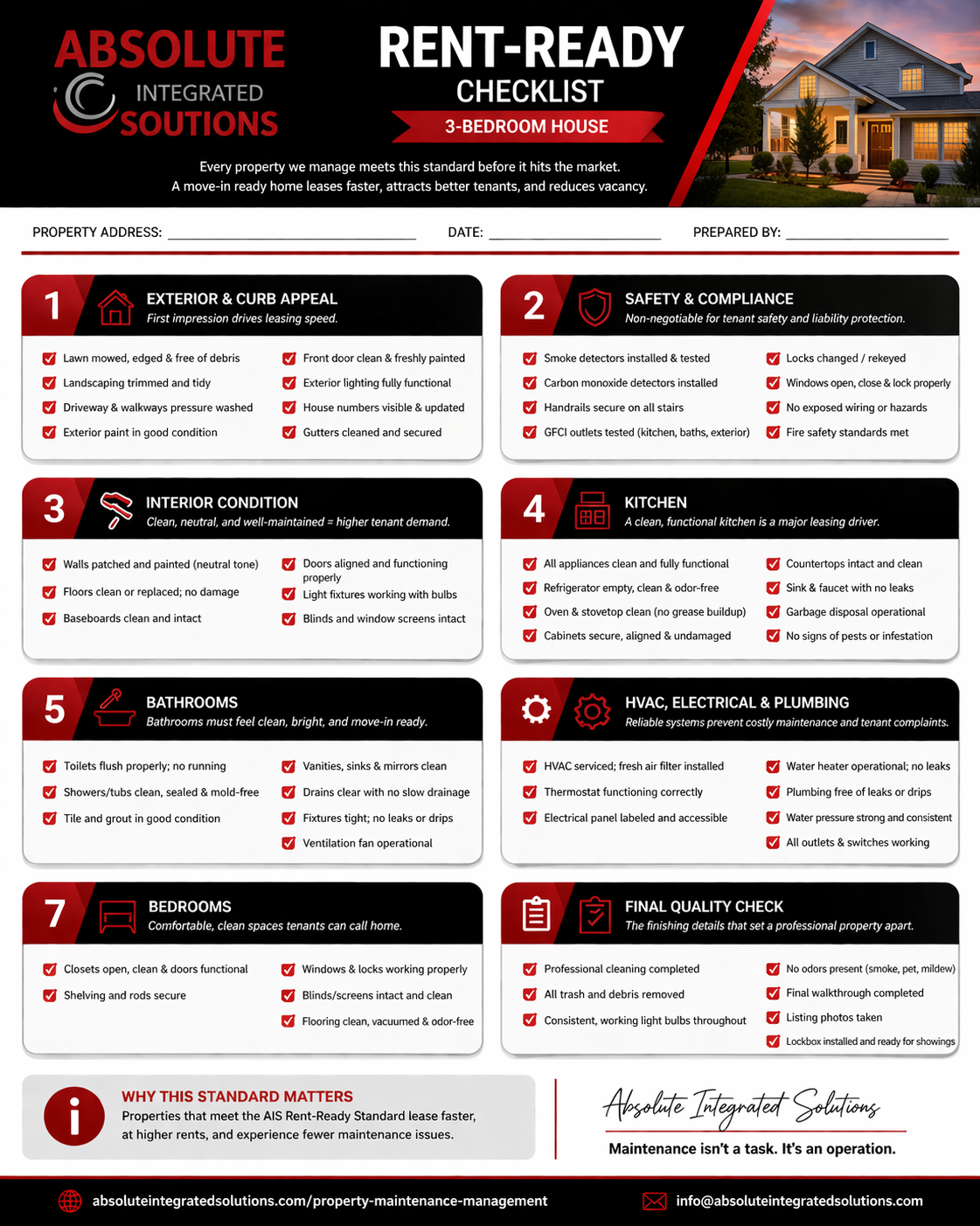
Consistent standards. Documented tracking. One operating cadence.
Every unit turn runs against the same rent-ready standard. Every scope is photographically documented. Every sign-off is recorded against the asset plan. The standard does not change by site, by technician, or by quarter — it is the operating cadence.
The discipline is what holds the asset to underwriting. The cadence is what makes the maintenance program legible to ownership. The reporting is what closes the loop between site execution and portfolio performance.
See the full Maintenance Management report ›The performance delta between a typical multifamily operation and one that is operated.
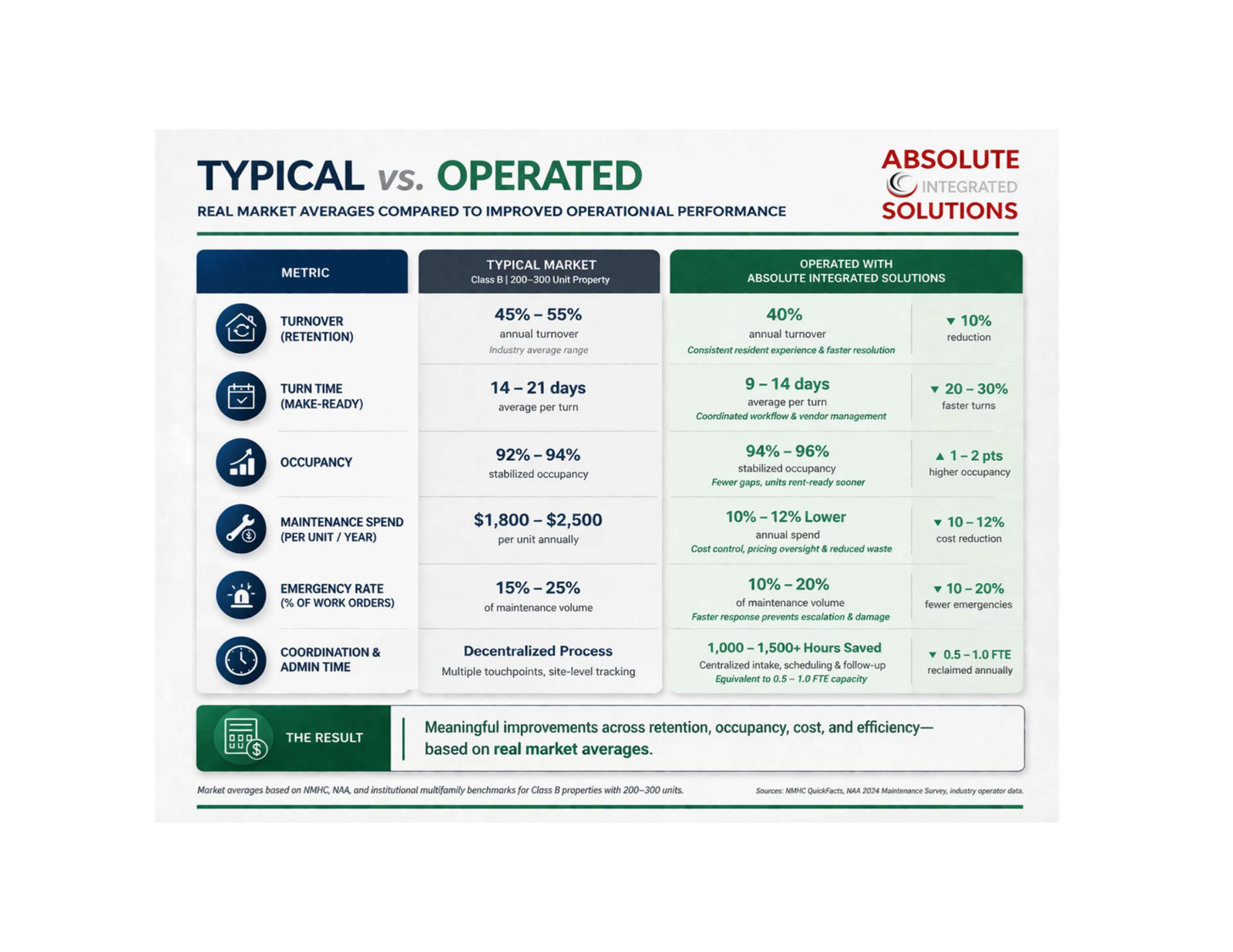
Industry averages tell one story. Operated assets tell another. The gains compound across retention, turn time, occupancy, maintenance spend, emergency rate, and coordination time — the operating metrics that move NOI line by line.
Lower turnover. Faster make-ready. Higher stabilized occupancy. Reduced per-unit operating cost. Fewer emergencies. Centralized coordination measured in reclaimed FTE capacity. This is what maintenance looks like when it is operated against the asset plan instead of dispatched against a work-order queue.
See the full Maintenance Management framework ›