
An inspection program is the operating record.
Without a documented inspection cadence, ownership inherits operational risk — disputed deposits, deferred capital surprises, scope drift on renovation draws, and a baseline that no longer exists when it’s needed.
A standardized program closes that gap. Every unit is documented against the same criteria, every turn is signed off to standard, and every capital project is verified against the scope it was funded for. The record is institutional — built for owners, asset managers, lenders, and IC review.
Four inspection types, one operating standard.
Move-In Inspections
Establish the baseline condition the entire lease cycle is measured against.
Room-by-Room Documentation
Standardized checklist confirms every unit is signed off to the same move-in standard.
Baseline Condition Record
High-resolution photo evidence captures the exact state of the unit at hand-off.
Dispute Defense
A documented baseline removes ambiguity from deposit and damage claims later.
Program Compliance
Units meet readiness standards required by HUD, LIHTC, and other program oversight.
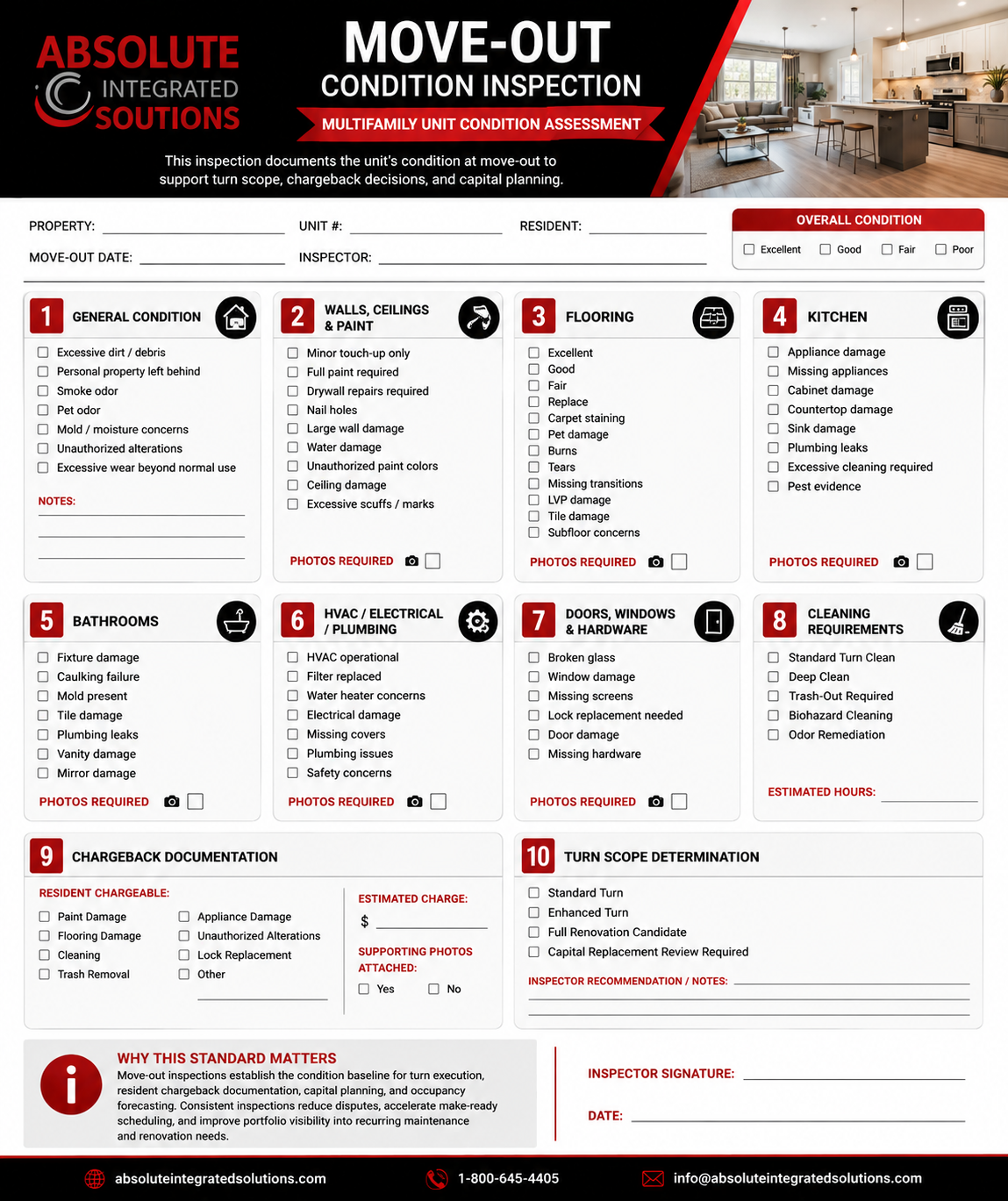
Move-Out Inspections
Recover legitimate costs, scope the turn, and get the unit back to market.
Damage vs. Wear
Distinguish recoverable resident damage from normal wear with a documented, defensible record.
Deposit Justification
Photo and line-item support for every deduction, reducing legal exposure and chargebacks.
Capital Need Surfaced
Identify larger repairs and upgrade opportunities that should be sequenced into the turn.
Turn Scoping
A complete scope on day one means trades are sequenced, days vacant compress, and rent recovers earlier.
Annual & Preventative Inspections
Catch small issues before they become unbudgeted capital events.
Early Detection
Surface leaks, moisture, and mechanical wear before they become emergencies.
Capital Planning
Forecast capital need on a documented cadence instead of reacting to surprises.
Emergency Cost Avoidance
Planned repairs avoid after-hours premiums, trip charges, and resident disruption.
Asset Longevity
Mechanical systems run on a maintained service interval, extending useful life.
Project & Capital Inspections
Verify that scoped, funded work matches what is actually delivered on site.
Scope Verification
Confirm trades are completing the scope the PO and draw schedule are paying for.
Quality Assurance
Workmanship measured against documented standards before sign-off or next draw.
Draw Discipline
Progress verified against milestones — no draw released against work not completed.
Final Sign-Off
Units released as move-in ready, with photo documentation tied to the project file.
Without a program, ownership inherits the dispute.
The cost of a missing inspection record is rarely on the operating statement — it shows up later, in deposit chargebacks, unbudgeted capital, draw disputes, and a baseline that no longer exists.
- ✗“He said, she said” deposit disputes
- ✗Deferred maintenance pile-ups surface as capital events
- ✗Unbudgeted emergency repair bills
- ✗Resident-caused damage absorbed by ownership
- ✗Capital draws released against unverified scope
- ✓Photographically documented baseline at every move-in
- ✓Repairs identified on cadence, sequenced into the plan
- ✓Capital expenditures planned, not reacted to
- ✓Documented record supports legitimate deposit recovery
- ✓Draws verified against completed, photographed scope
One standard across every unit, every asset, every market.
Whether the portfolio is five units or five hundred, the inspection protocol is the same. Same criteria, same documentation format, same data structure. The result is a portfolio-wide record that supports analysis, comparison, and reporting — not a stack of inconsistent one-off reports.
Inspection programs tuned to portfolio type.
Scattered-Site, Single Standard
Scattered-site inspections coordinated against a single protocol — exterior, structural, and grounds inspected against the same criteria across every market the portfolio touches.
Unit-by-Unit, Asset-Wide
Sequenced unit sweeps, common-area and life-safety inspections, and mechanical-room reviews built for institutional multifamily and program-funded assets.
Project-Level Verification
Draw-tied inspections, scope verification, and photo-documented sign-off built for portfolio renovations, unit-upgrade programs, and post-stabilization handoff.
What every inspection report includes.
A consistent record format every time — built so the same data can be read by an asset manager, a lender, and an IC committee without translation.
High-resolution images tied to room and item, timestamped and attached to the property record.
Same room-by-room criteria across every unit — results aggregate cleanly across the portfolio.
Plain-language summary distinguishing immediate, scheduled, and capital action items.
Scoped, prioritized action list with cost framing — ready to convert to work orders or PO.
Items relevant to HUD, LIHTC, insurance, or local code surfaced explicitly, not buried.
Inspector, date, and unit ID attached to every report — defensible audit trail by design.
Reports aggregate to portfolio-level views — capital need, condition trend, compliance status.
Written in language asset managers, lenders, and IC reviewers can read without re-formatting.
Historical reports remain accessible per unit — the operating record is never re-created from memory.
Build the operating record before it’s the missing record.
A consultation walks the inspection cadence, report format, and operating fit for your portfolio — sized to unit count, asset type, and reporting requirements.